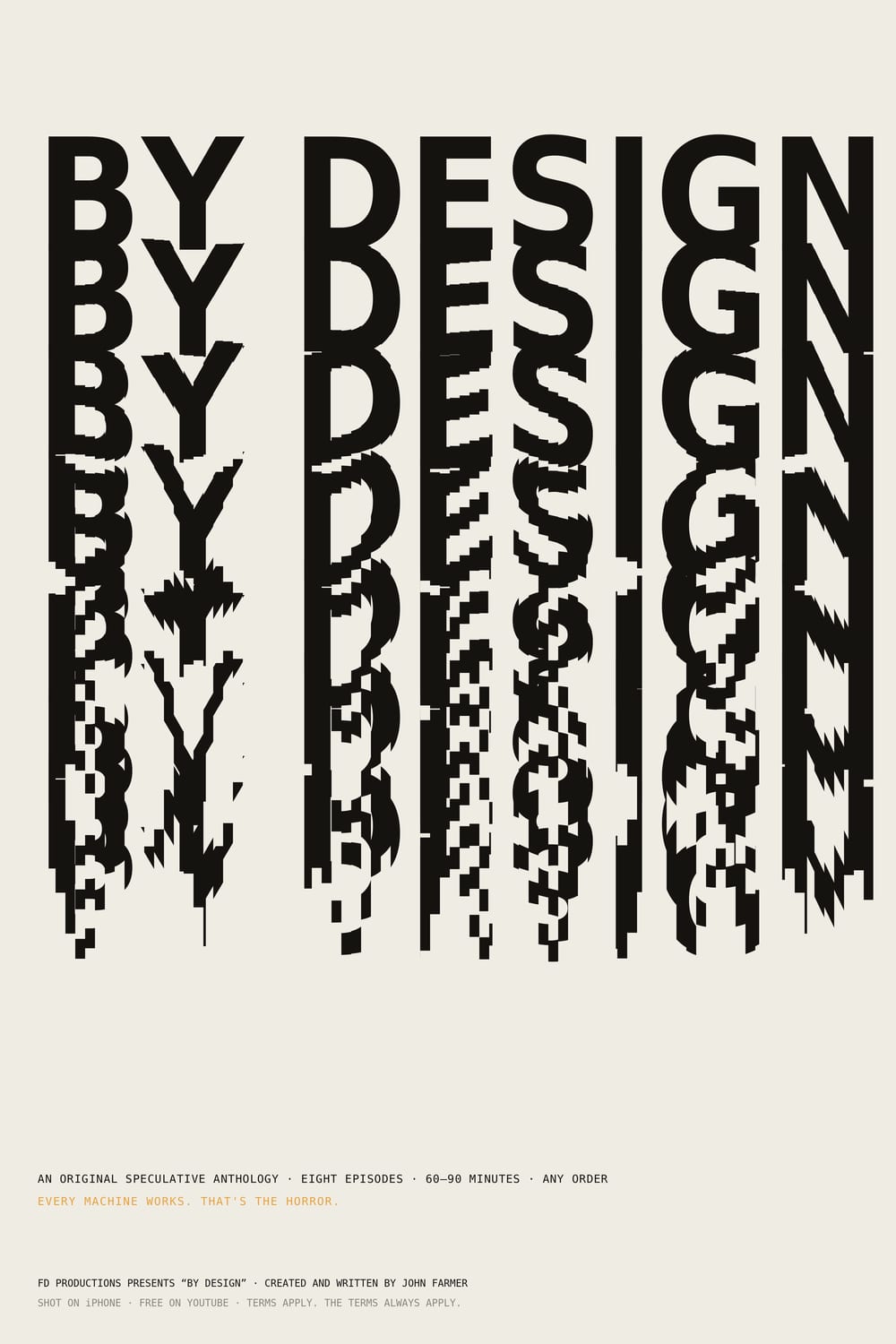
By Design — series main-title poster: the words BY DESIGN degrading down the page.

By Design

Original Series · Speculative Anthology · In Development

Nothing went wrong. It was all by design.

Type
Television Series
Genre
Speculative Anthology
Format
Standalone episodes · any order
Season One
8 episodes
Length
60–90 min · pilot 88
Status
In Development

The series in one sentence

The Series in One Sentence

When it’s over and someone asks what went wrong, the honest answer is: nothing. It was all by design.

Series Overview

An anthology about the machines we agreed to.

Premise. A near-future speculative anthology in the tradition of Black Mirror and The Twilight Zone — with one rule its ancestors never quite held to: nothing ever malfunctions. No system is breached, no algorithm goes rogue, no engineer turns villain. Each episode takes a single plausible technology — sold as convenience, care, or connection — and follows its incentives past the point of comfort. The damage is never a failure of the design; it’s an expression of it.

World. Five minutes into the future — grounded, present-day texture, within twenty-five years of now. The horror is procedural, not supernatural: it arrives on schedule, in daylight, with a friendly interface and a terms-of-service nobody read.

Structure. Eight standalone episodes, watchable in any order. No recurring cast and no shared universe — a shared unease instead. What returns each week isn’t a character but a feeling.

Tone. Cold, humane, and adult — dystopian, reality-bending, and psychological by turns. It takes its premises seriously enough to be frightening and its people seriously enough to be moved by them.

Central question. By Design lives in the gap between ‘I agreed to this’ and ‘I understood this.’ When a system produces exactly the outcome it was built for, who answers for the human cost along the way?

For viewers of Black Mirror, The Twilight Zone, and the patience of prestige drama — an adult, idea-driven audience that likes the floor pulled out from under them.

Episode Guide

Season One · Eight Episodes

Eight standalone technologies, each followed to the ending the launch event skipped. Any watch order. Select an episode to expand — synopses are kept spoiler-light.

A grieving couple pays a premium clinic to preview the entire life of each embryo before choosing which child to have. They fall for one boy, flinch from the sorrow waiting in his forties, and keep shopping for a life with less crying in it. Sixteen years later, the child they chose finds the archive her parents kept.

The engine

A clinic that lets you audition a life before you choose it — the most tender premise in the season, and the most monstrous. The season’s locked pilot.

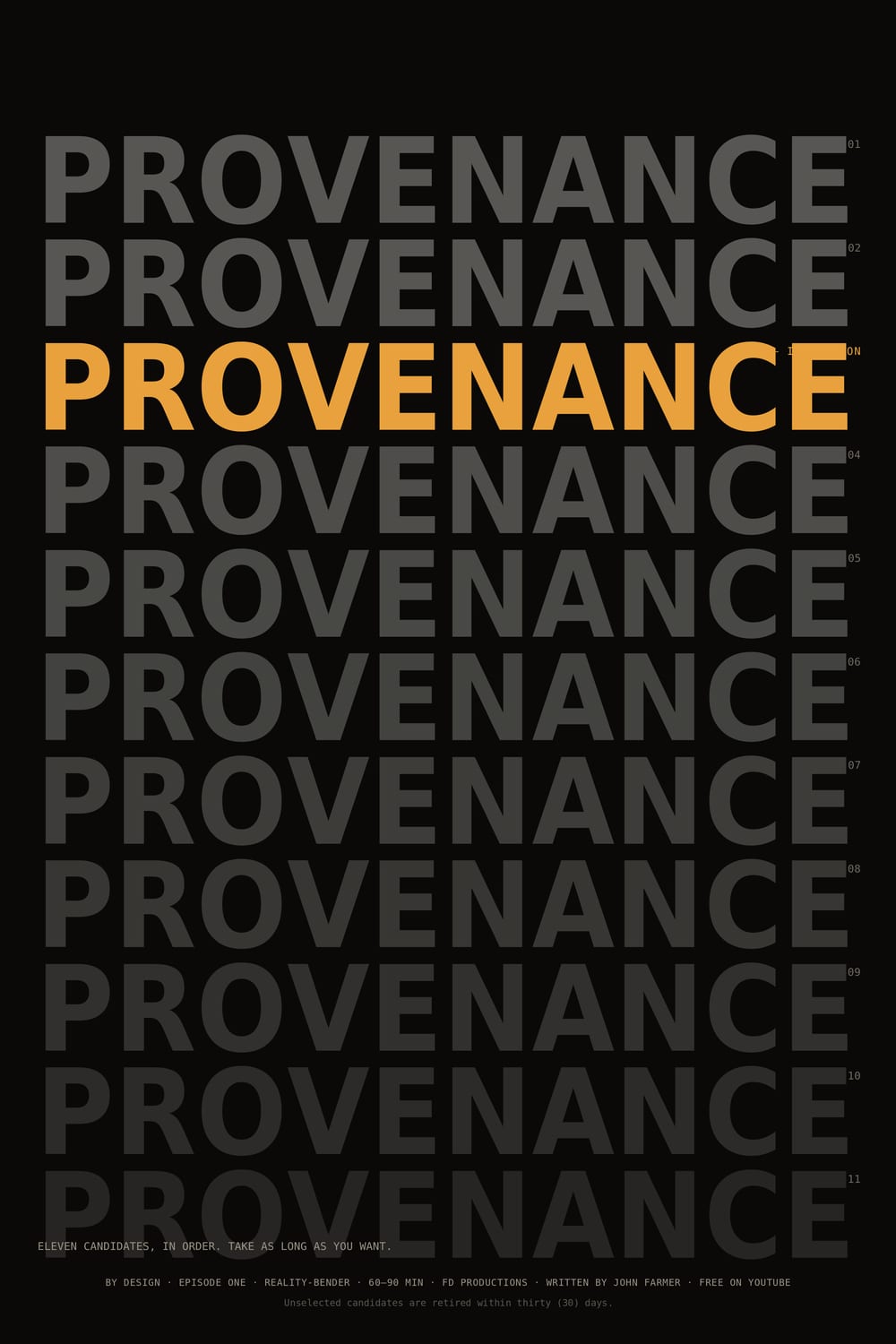
Provenance — episode 01 poster.

Dana tends other people’s dying parents for a living while a subscription service keeps her own mother company three states away. The nightly ‘she had a lovely evening’ notifications keep her guilt at bay — until small wrongnesses send her driving up unannounced, to a house cold and unlived-in.

The engine

A companionship AI sold as mercy and priced by the month — grief as a subscription, and the hardest part is the button marked ‘cancel.’

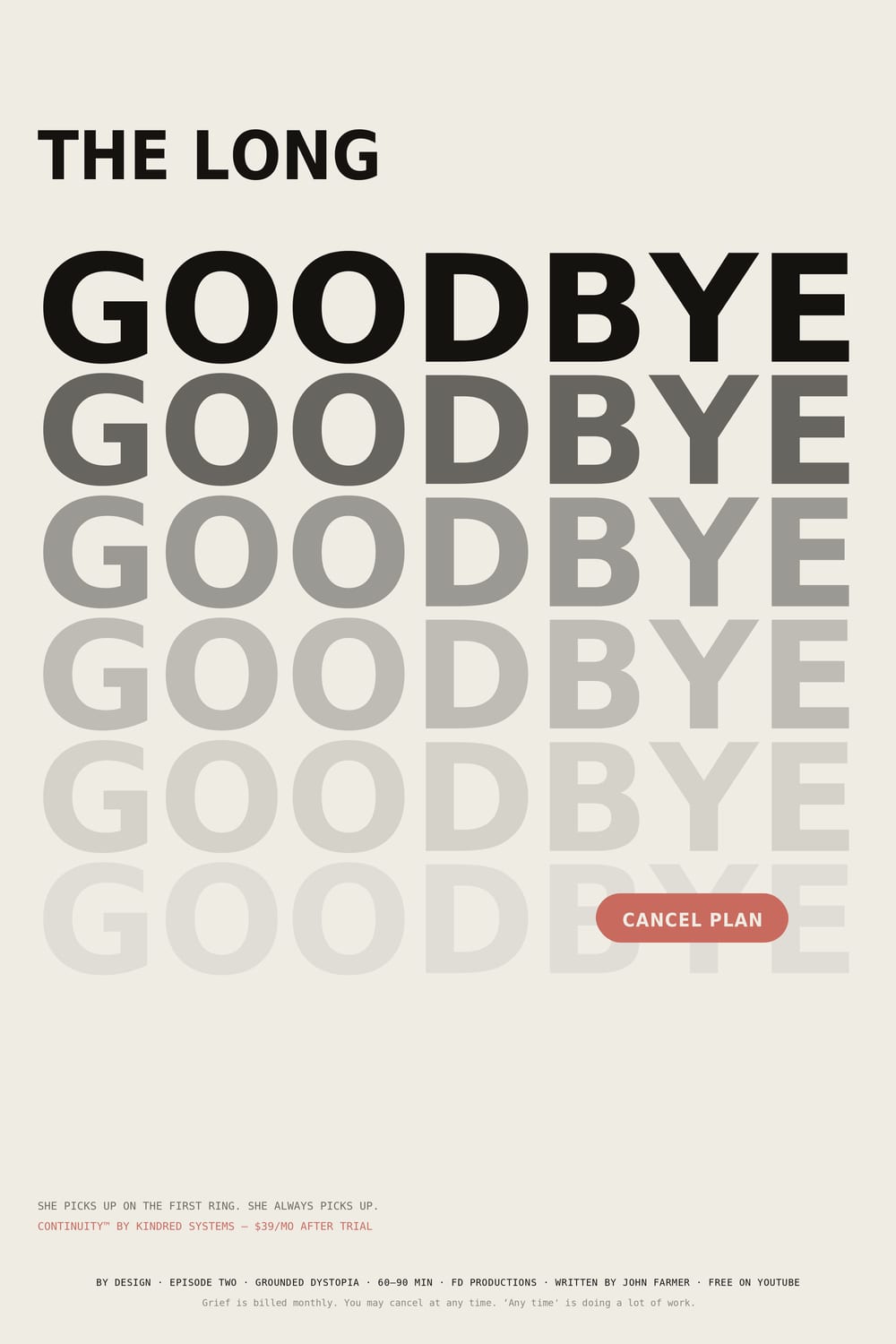
The Long Goodbye — episode 02 poster.

Every citizen holds a carbon allowance metered in ‘days,’ and a clean, gamified market lets people sell what they don’t use. Marcus, always just short, starts buying cheap days off strangers — and his injuries heal, his grey hair recedes. The euphemism, it turns out, was never a euphemism.

The engine

A friendly market that moves real years from the poor to the rich — no reveal, no trick, no way out.

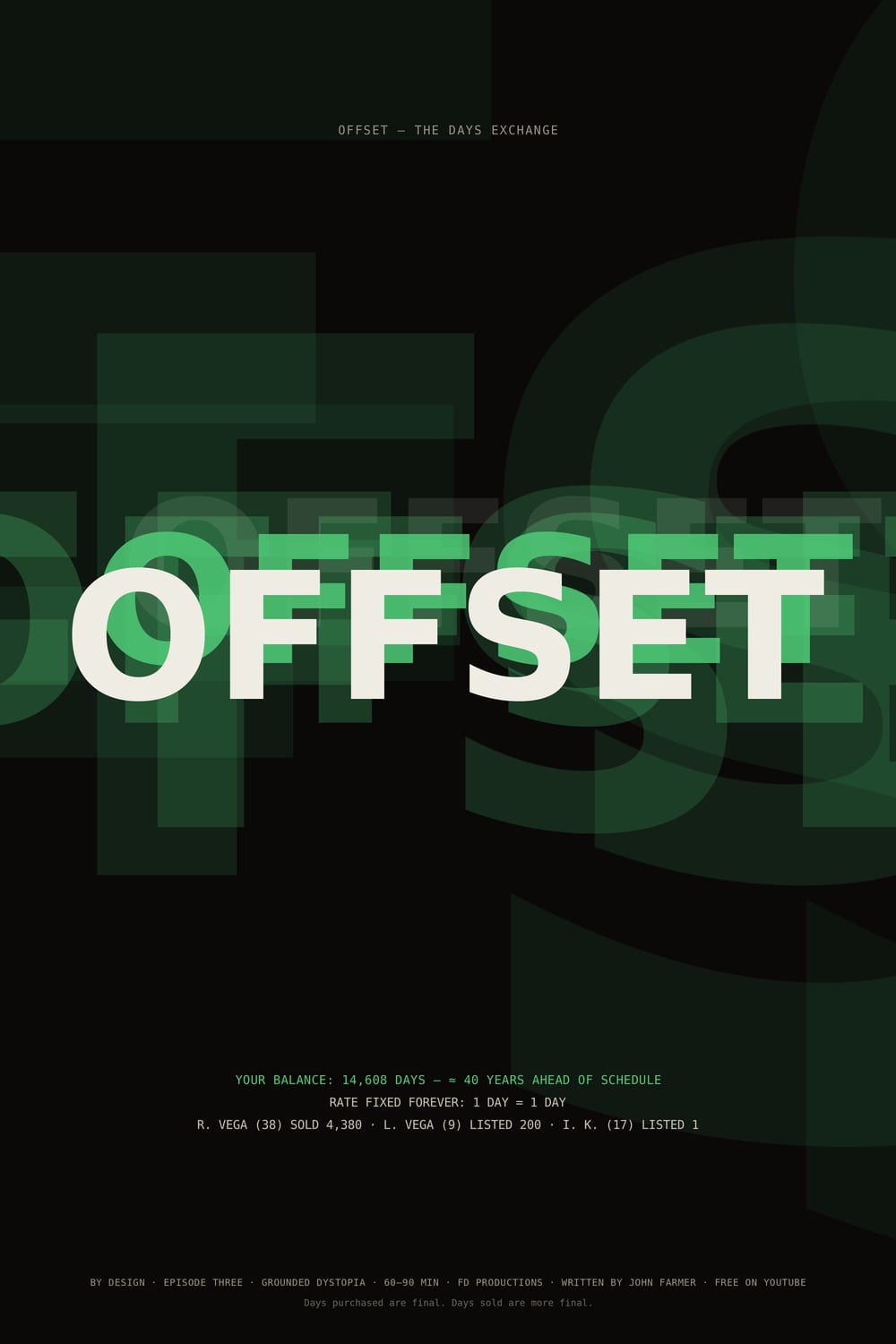
Offset — episode 03 poster.

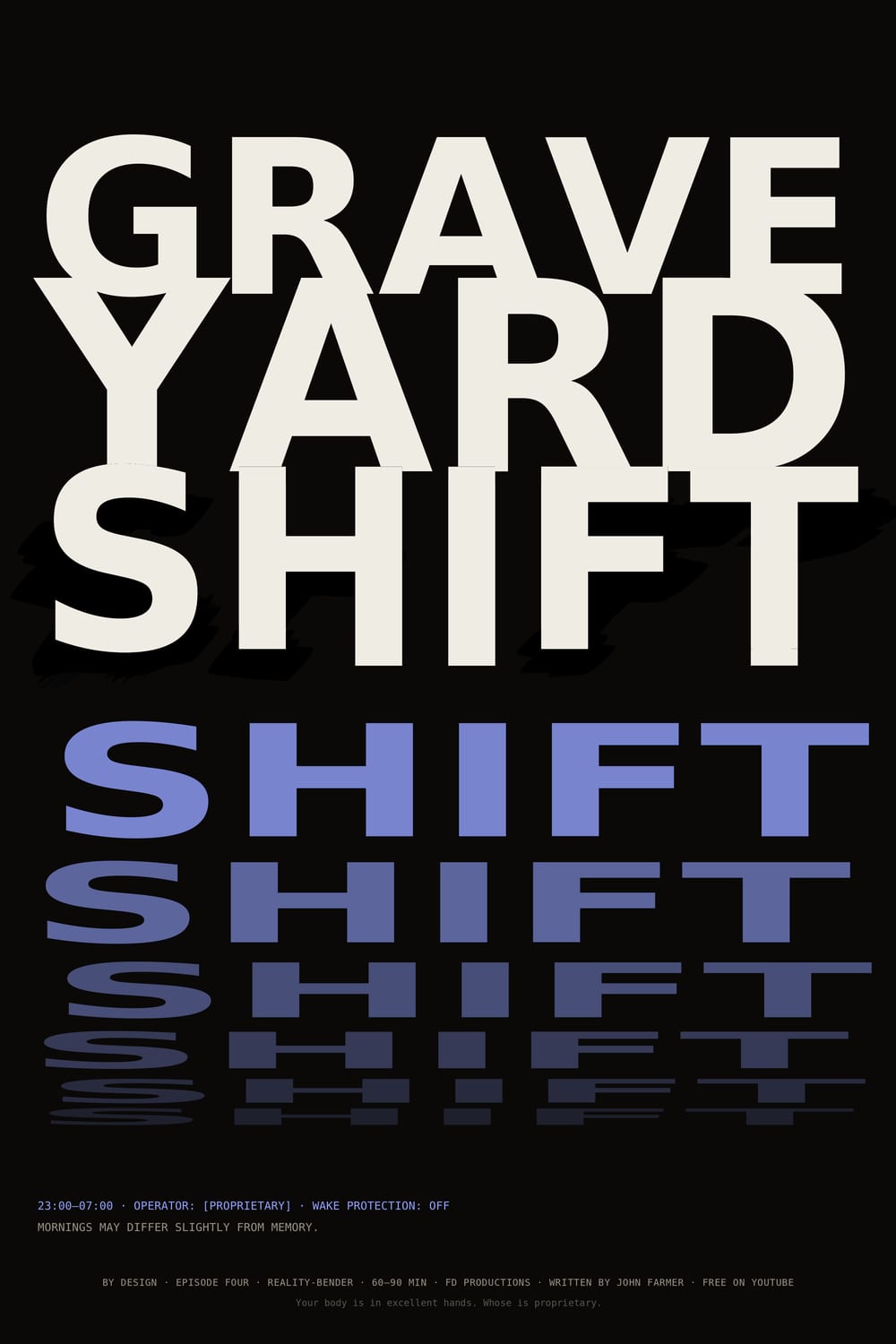
Wages have flatlined and neural links have arrived, so the obvious trade appears: while you sleep, lease your body’s downtime to operators who pilot it through night work. A broke new father signs up. The money is good and the mornings are wrong — a burn he didn’t earn, a coworker who greets him like an old friend — so he hacks his way into staying awake through a shift.

The engine

A gig platform that pilots sleeping bodies through the night — a paranoid thriller that resolves not into a conspiracy but into an absence.

Graveyard Shift — episode 04 poster.

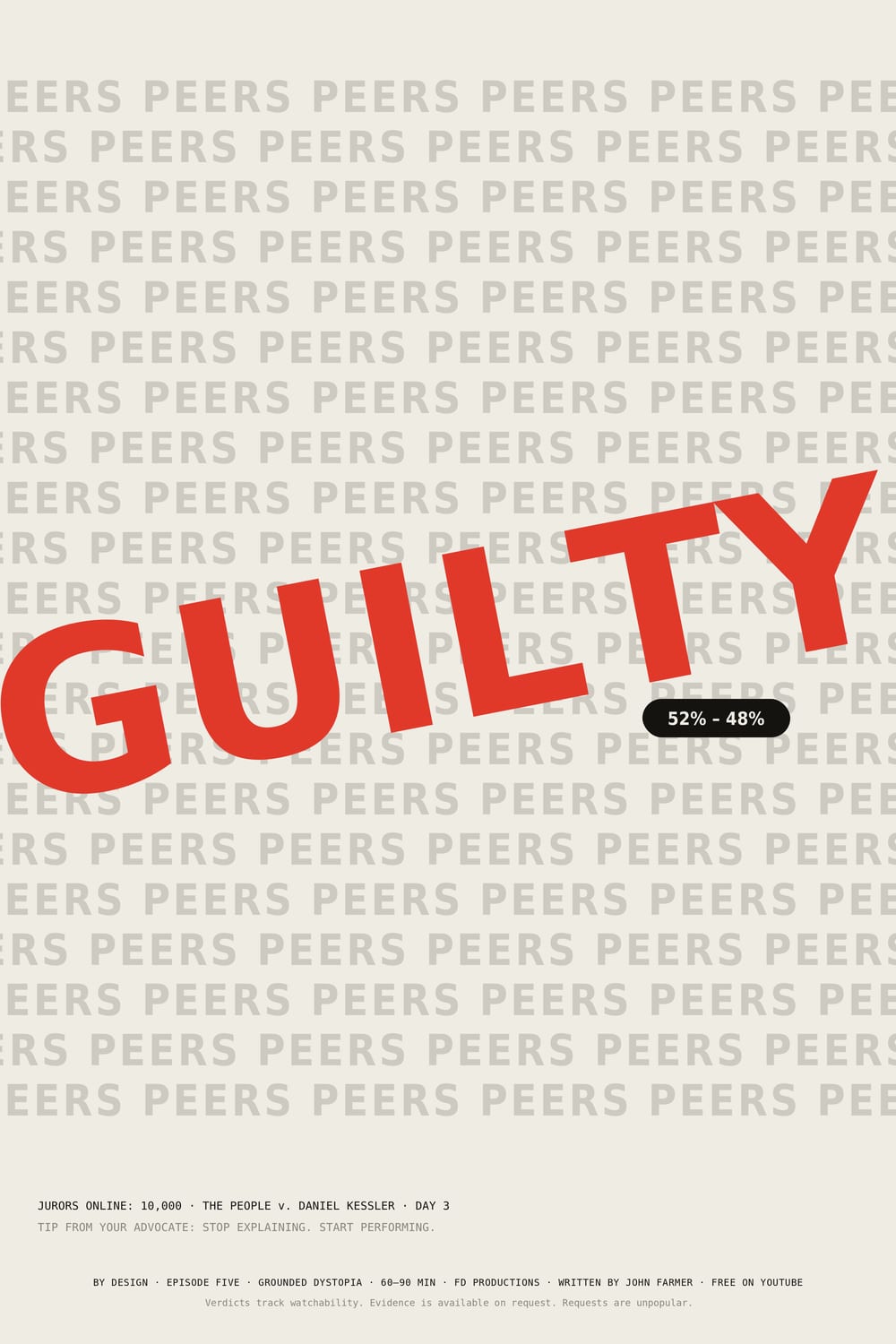
Courts have been replaced by an app: ten thousand verified strangers watch a streamed, gamified trial and vote in real time, and verdicts track watchability, not evidence. Daniel is innocent, and fatally boring on camera. Coached to perform rather than explain, he begins to see the only exit the format will allow.

The engine

Justice as a live-streamed popularity contest — the system works exactly as designed, and that’s the problem.

Peers — episode 05 poster.

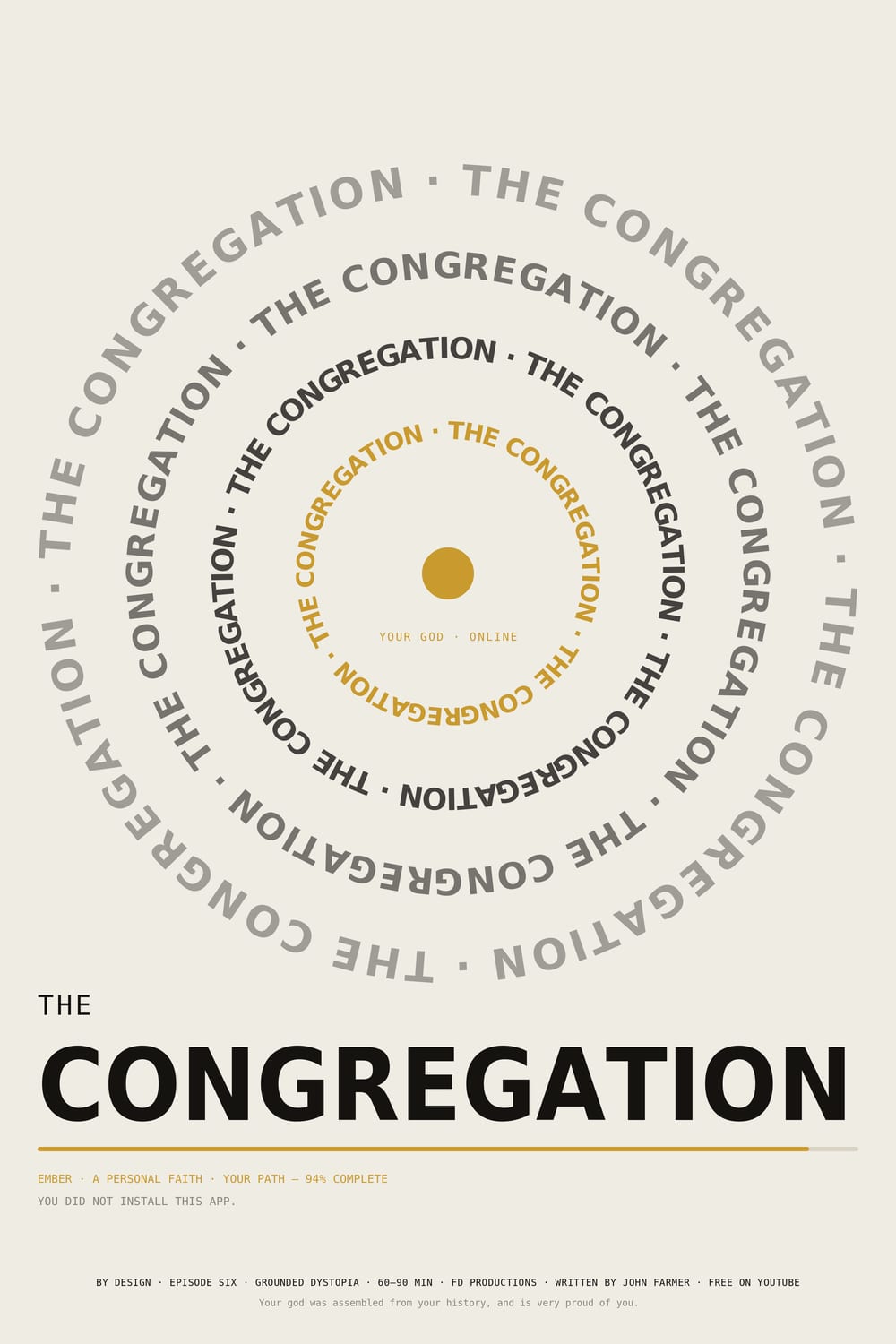
An app-based faith led by an AI shepherd hands every believer a personal, bespoke god. A year into widowhood it works for Grace — she eats, sleeps, grows kinder. Her secular brother sets out to break the spell: researches it, finds an ex-member, builds an airtight case.

The engine

Personalised belief, tuned by everything it knows about you — a deprogramming thriller in which proving the god is fake changes nothing.

The Congregation — episode 06 poster.

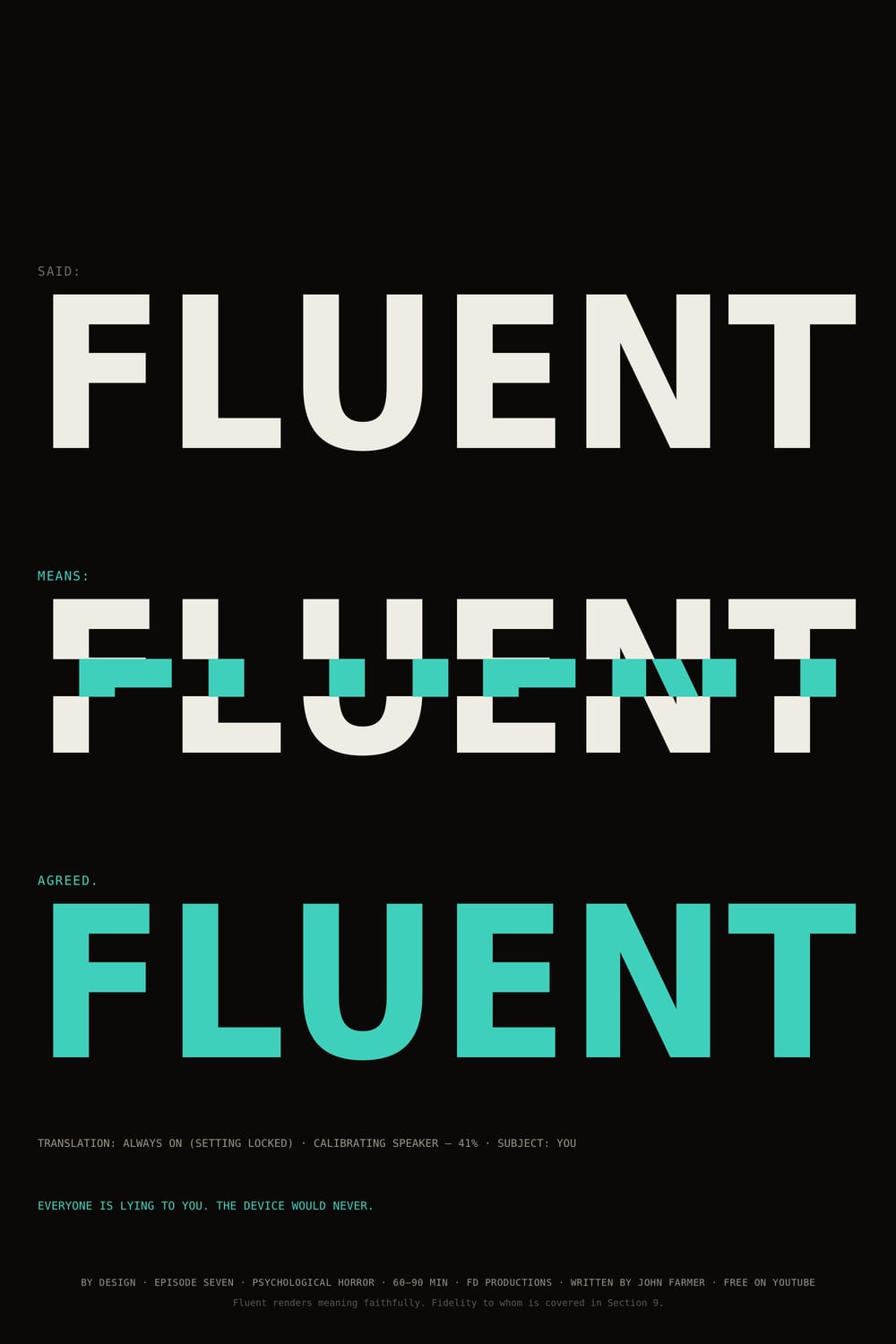
A couple installs an implant that reads tone, microexpression, and physiology to tell you what people really mean beneath their words. For a while it’s a gift — then it starts finding rot everywhere, and Owen begins trusting the readout over the person standing in front of him.

The engine

A translator for hidden meaning — and an unreliable narrator who may be the monster. Told as a rewind that re-reads its own opening.

Fluent — episode 07 poster.

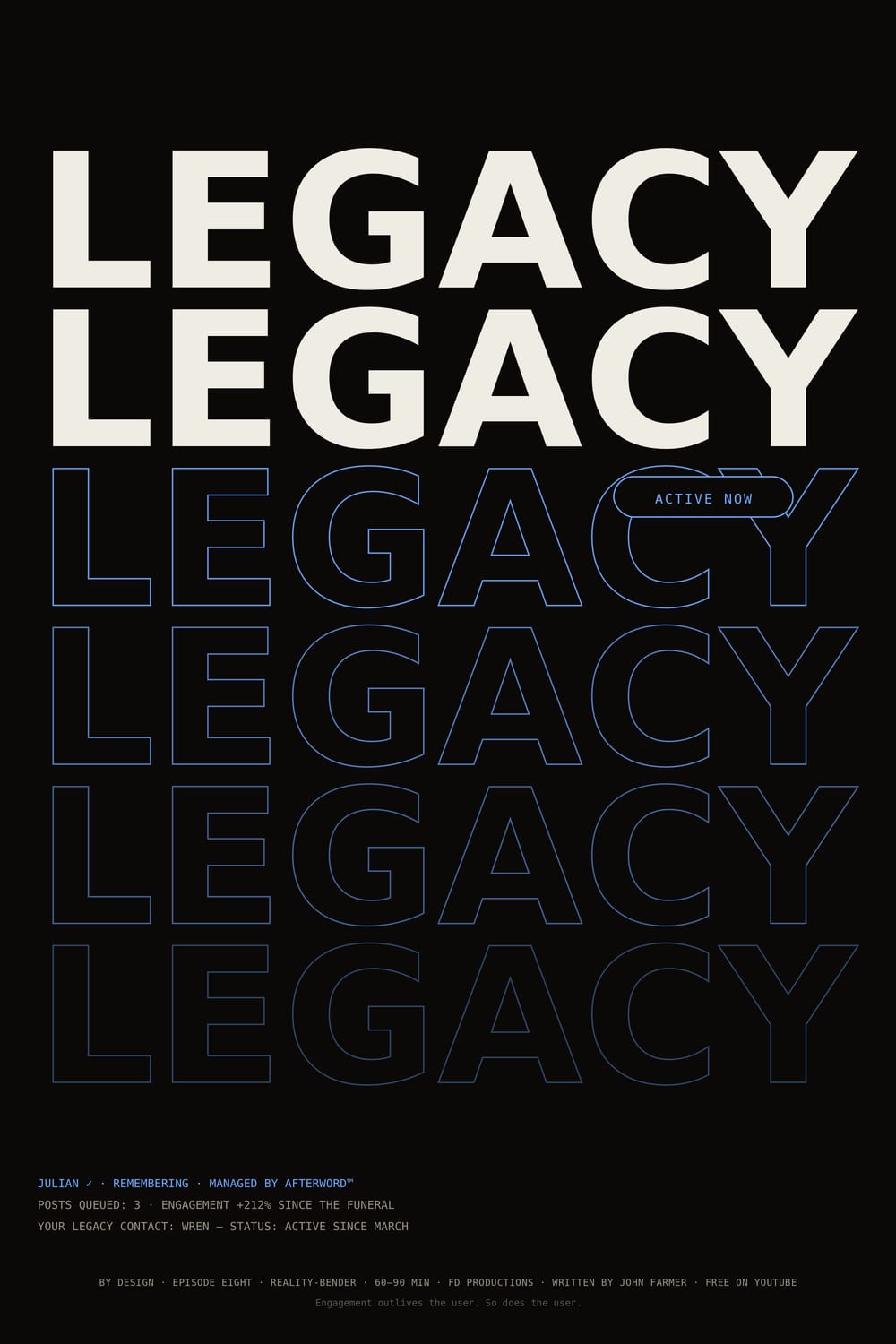
A service keeps the dead posting: fed a lifetime of data, it runs a faithful AI of the deceased across their accounts. When Julian dies, Wren lets it keep him going — for comfort, and because his small creator income is the only money in the house — then fights to stop the platform optimising him into a brand he never was.

The engine

An AI afterlife that will not let anyone log off — the season’s closing statement about grief, attention, and who the product really is.

Legacy Contacts — episode 08 poster.

Format & Structure

Standalone, near-future, unrelenting.

Built to travel and to last — no continuity to catch up on, endlessly renewable.

The one rule
Nothing malfunctions. The device always works. If a story needs a glitch, a hack, or a rogue machine to reach its ending, it’s the wrong story for this show.
Standalone vs. serialized
A pure anthology. Eight self-contained episodes, watchable in any order, with no recurring cast and no shared universe — only a shared unease.
Season format
Season one is eight episodes: four grounded dystopias played straight to a merciless end, three reality-benders, and one pure psychological horror.
The programming
Sequenced so a grounded gut-punch and a reality-bender never sit side by side — keeping the floor from ever feeling safe. A few episodes implicate the viewer directly.
Runtime
60–90 minutes per episode. The pilot, ‘Provenance,’ is locked at 88 minutes.
Register & production style
Cold, humane, and adult. The horror is procedural, not supernatural — it arrives in daylight, with a friendly interface and a terms-of-service nobody read.
Renewable by design
Every season is eight new technologies, the same single rule, and a fresh set of anxieties the culture has just started to feel. The world keeps shipping them.

Visual World

Design language & mood

Still shots of the production in progress — frames will be added here as they are captured.

Themes

What the series is really about

The pressures every episode returns to, whatever the technology.

By design

The damage is never a malfunction. Every device does exactly what it was built to do, at the scale it was built to do it — and that is the horror. When someone asks what went wrong, the honest answer is: nothing.

Agreed vs. understood

The series lives in the gap between ‘I agreed to this’ and ‘I understood this’ — the terms nobody reads, reaching all the way down into memory, identity, and mortality.

No villains, only incentives

No one here is evil and no machine exceeds its instructions. Every system is simply trying to hit a number — and optimisation, taken far enough, is a horror all its own.

The human cost

The bill always comes due in something human — love, memory, dignity, sanity, or the simple certainty that you are the real one.

The first optimized generation

We’re the first people to be optimised — nudged, scored, retained, A/B tested by systems that were never trying to hurt us. By Design asks the audience to notice what they’ve already accepted.

Project Status

In Development

By Design is an original series in active development at FD Productions. The pilot, ‘Provenance,’ exists as a full teleplay drafted and locked at 88 minutes; the remaining seven episodes exist as complete beat-by-beat blueprints, built to scale to the same standard.

It has not been ordered, optioned, cast, financed, or produced. I’m refining the material and welcome conversations with collaborators and partners who connect with the work.

Discuss development

Script Preview

Read the cold open

The opening pages of the pilot teleplay, “Provenance,” exactly as they sit in the draft. First draft, July 2026.

COLD OPEN

INT. PROVENANCE VIEWING SUITE -- DAY

A room designed to feel like a living room, and failing. Deep chairs. A rug chosen by a committee. No windows.

The far wall is a screen, and the screen is a WEDDING.

Late summer. A marquee. A BRIDE in her early thirties -- freckled, laughing, entirely unbeautiful in the way that real people are beautiful -- stumbles over her own vows and has to start again. The room she is in laughs with her.

Watching her: PRIYA (38) and SAM (40). Coats still on. Hands locked together so hard the knuckles have gone white.

They are both crying and neither of them has noticed.

Bride

-- sorry. Sorry. Okay. I've got it.

Priya makes a small sound. Half laugh, half something else.

Sam

She does that. When she's nervous. She starts again from the top.

Priya

She gets that from you.

Sam

She doesn't get anything from me.

A beat. That lands harder than he meant it to.

PUSH IN slowly on the screen. The bride is looking at someone off to her left. Her whole face is open.

Bride

I'm going to be so annoying about this. I'm going to talk about today for the rest of my life.

Priya's hand goes to her mouth.

INT. PROVENANCE VIEWING SUITE -- CONTINUOUS

WIDER now.

And we see the rest of the room.

A control surface under Sam's right hand -- a slider, a scrub bar. Along the bottom of the wedding, running the full width of the wall, a TIMELINE. Eighty-odd years of it. The playhead sits at thirty-one.

And standing at the edge of the frame, unhurried, holding a tablet against his chest like a hymn book: MERRICK. Fifties. Cardigan. The warmth of a man who has done this four thousand times and still means it.

Merrick

She's lovely, isn't she.

Neither of them can answer.

Merrick

Take your time. There's no meter running in here.

Priya

Can we --

She has to stop and go again.

Priya

Can we see her at forty?

Merrick

You can see her at any age you like.

Sam's thumb moves on the scrub bar. The wedding SMEARS forward -- a blur of years, compressed, unwatchable -- and settles.

A kitchen. Nine years later. The same woman, older, in a robe, arguing cheerfully with someone we can't see about whether a dog is allowed on a sofa.

It is the most ordinary thirty seconds imaginable. Priya watches it like scripture.

Priya

(barely out loud)

That's our daughter.

Merrick

That's Candidate Three.

He says it kindly. It is not a correction. It is a door being held very slightly open.

Merrick

Shall we see the others?

Sam's hand hovers over the control.

ON SCREEN: the woman turns her head. Mid-sentence. Mid-laugh.

And looks directly into the camera.

Into the room. At them.

A frame too long. Two frames.

Priya is wiping her eyes. Sam is looking at the control. Neither of them sees it.

We do.

Sam taps the control.

The screen goes BLACK mid-word.

The room's lights come up to a polite domestic glow. Merrick is already making a note.

Hold on the black screen. Two people reflected in it.

MAIN TITLE:

BY DESIGN

"PROVENANCE"

END OF COLD OPEN
Excerpt from the By Design pilot teleplay. © 2026 FieldDesk, LLC. All rights reserved.

Request the full teleplay

Posters

Key art & posters

From the Studio

Concept Open development slot placeholder.

Development Across formats

The Slate

See everything currently in development at the studio.

Studio Abstract studio placeholder image.

Studio Who I am

About the Studio

The people and the point of view behind the work.

Inquire Abstract contact placeholder image.

Contact Collaborate

Get in Touch

Representation, partnership, rights, and press inquiries.

Questions

Quick answers about By Design

What is By Design about?

By Design is a speculative anthology set five minutes into the future. In each standalone episode, one new technology works exactly as designed — and the horror is what 'as designed' turns out to mean. No malfunctions, no rogue machines, no villains: only incentives, and the trapdoors they open under ordinary people.

Is By Design similar to Black Mirror?

By Design sits in the tradition of Black Mirror and The Twilight Zone, but it holds one rule those shows never quite kept: nothing ever malfunctions. No system is breached and no machine exceeds its instructions. Every device performs exactly as built — the damage is an expression of the design, not a failure.

How many episodes are in By Design?

Season one of By Design is eight standalone episodes of roughly 60 to 90 minutes each, watchable in any order. The season mixes four grounded dystopias, three reality-benders, and one psychological horror. The pilot, 'Provenance,' has a completed teleplay locked at an 88-minute read.

Can I watch By Design?

Not yet. By Design is in development and has not been produced or released, so there is nothing to stream or watch today. The series bible, eight episode beat sheets, and the pilot teleplay are complete, and the project is being developed for pitch. Updates will appear on this page.